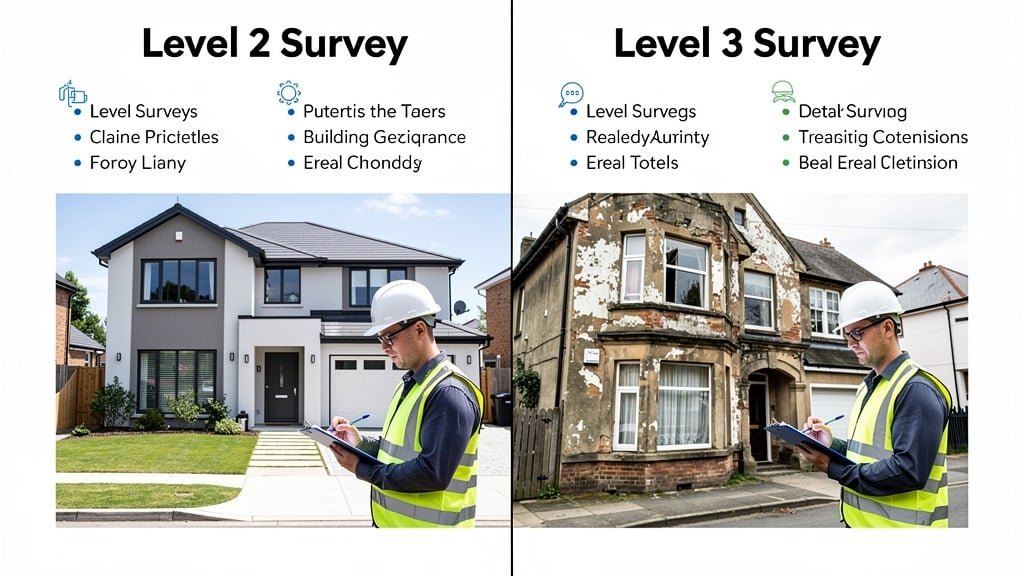
Bath Surveyors UK gets asked this question more than almost any other: "Do I need a Level 2 or Level 3 survey?" It's one of the most important decisions you'll make during a property purchase — and yet it's genuinely confusing, even for people who've bought property before. In this guide, we'll break down exactly what each survey covers, who it's right for, and how to make the right call for your specific property.
"I've spoken to hundreds of buyers who've made the wrong choice — usually erring towards the cheaper option. In some cases, that decision has cost them tens of thousands of pounds in unexpected repairs." — Jonathan Harper, Principal Surveyor, Bath Surveyors UK
What Are RICS Home Survey Levels?
First, a bit of background. In 2021, RICS (the Royal Institution of Chartered Surveyors) updated and standardised its residential survey formats. Previously, surveyors offered a range of differently named products — Condition Reports, Homebuyer Reports, Full Building Surveys — which confused buyers no end. The new RICS Home Survey Standard simplified this into three clear levels:
- RICS Home Survey Level 1 — a basic condition survey, rarely used for property purchases
- RICS Home Survey Level 2 — the former "Homebuyer Report", suitable for conventional properties
- RICS Home Survey Level 3 — the former "Full Building Survey", the most comprehensive option
In practice, most buyers are choosing between Level 2 and Level 3. Level 1 is mostly used by lenders and for very straightforward modern properties. So let's focus on the two that matter most.
What Does a Level 2 Homebuyer Survey Include?
A RICS Level 2 homebuyer survey is a mid-range survey designed for conventional properties in reasonable condition. In Bath, that typically means properties built from the mid-20th century onwards, or older properties that have been significantly modernised and appear to be in good condition.
Here's what you get with a Level 2 survey:
- A condition rating for every major element of the property, using a traffic light system (Condition Rating 1 = OK, 2 = needs attention, 3 = urgent)
- Assessment of the main building, services and grounds
- Identification of significant defects that affect the property or could affect the value
- Advice on defects that need immediate repair and items requiring ongoing monitoring
- Legal matters to raise with your solicitor
- Market valuation (optional add-on)
- Reinstatement cost for insurance purposes (optional add-on)
What a Level 2 survey doesn't include: it's not as in-depth as a Level 3. The surveyor won't lift floorboards, move furniture, open every hatch, or provide a detailed description of the property's construction methods. It's a visual survey of accessible areas.
What Does a Level 3 Building Survey Include?
The RICS Level 3 building survey (sometimes called a full structural survey, though this term isn't technically correct anymore) is the most thorough residential survey RICS offers. In Bath, we recommend it for any pre-1940 property, listed buildings, unusual structures, and properties in poor or unknown condition.
A Level 3 survey includes everything in a Level 2, plus:
- A much more detailed description of the property's construction and the materials used
- In-depth analysis of any defects found, including their likely cause and severity
- An assessment of areas not usually covered in a Level 2 (e.g., service void, above false ceilings where safe)
- Detailed advice on the range of remedial works required and likely costs
- An opinion on the urgency of repairs
- Recommendations for further specialist investigations (e.g., drainage survey, electrical inspection)
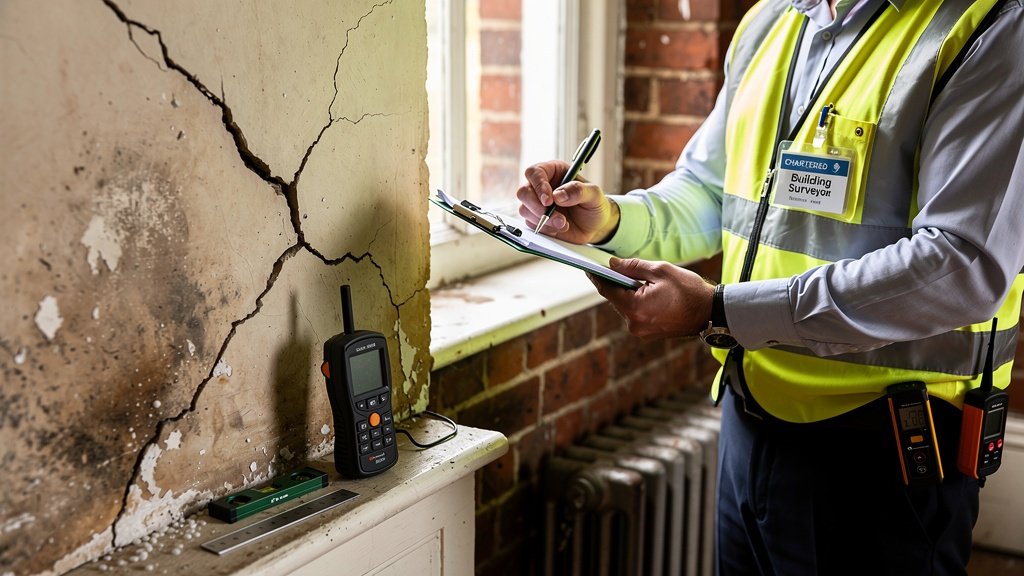
Which Survey Do You Need for a Bath Property?
This is where local knowledge really matters. Bath's housing stock is unlike almost any other UK city. Over 5,000 listed buildings, hundreds of Georgian terraces built 200–250 years ago, Victorian and Edwardian properties galore, and a sprinkling of converted historic buildings. Here's our general rule of thumb:
Bath Surveyors UK Recommendation
If the property was built before 1940, or if it's a listed building, or if you have any doubt about its condition — always go for a Level 3 building survey. The additional cost (typically £200–400 more than a Level 2) is almost always worth it for the extra peace of mind and depth of information you'll receive.
Choose a Level 2 survey if:
- The property was built after 1940 and appears to be in good condition
- It's a purpose-built flat in a modern block
- It's a conventional, straightforward property with no obvious structural concerns
- You're buying as an investor and simply need a quick condition overview
Choose a Level 3 survey if:
- The property was built before 1940 (and especially before 1900)
- It's a listed building or is within a conservation area
- It's a large, unusual or unusual-construction property
- The property appears to be in poor condition or has had significant alterations
- You intend to renovate, extend or significantly alter the property
- The property is a converted barn, chapel, or other non-standard building
Real-World Example: A Georgian Townhouse in Bath City Centre
Let me give you a real example from our recent work. A client — I'll call her Sarah — was buying a Georgian flat in the centre of Bath. It was a beautiful property, well-presented and recently decorated. Her solicitor suggested a Level 2 homebuyer survey to keep costs down.
Sarah came to us for a second opinion. Based on the property's age (circa 1790), its location in a listed terrace, and the fact that it had a basement, we recommended a Level 3 survey. Sarah agreed.
During the inspection, our surveyor found significant rising damp in the basement, a failing damp-proof course, evidence of structural movement in the rear wall, and a roof structure that hadn't been touched since the 1960s. Total estimated repair costs: over £30,000. Sarah used the report to negotiate a £25,000 price reduction — a saving many times the cost of the survey itself.
How Much Does Each Survey Cost in Bath?
Survey costs vary depending on the size, age and type of property. As a rough guide:
- Level 2 homebuyer survey: from £450 for a small flat to £700+ for a large house
- Level 3 building survey: from £700 for a small property to £1,150+ for a large or complex property
For a precise quote, use our survey cost estimator or get in touch with our team directly.
Frequently Asked Questions
Yes — as long as the inspection hasn't yet taken place, we can usually upgrade your survey. Just get in touch as soon as possible.
Yes, we always recommend a Level 3 building survey for any listed property, regardless of its apparent condition. The unique construction of listed buildings and the legal responsibilities that come with them make a thorough inspection essential.
A Level 2 survey typically takes 2–3 hours on site. A Level 3 survey usually takes 3–5 hours, depending on the size and complexity of the property.
Still Not Sure Which Survey to Choose?
Our team is always happy to advise. Get in touch with Bath Surveyors UK and we'll give you an honest recommendation based on the specific property you're buying — with no obligation to book.

Jonathan has over 30 years of experience surveying residential properties across Bath and the surrounding Somerset areas. He founded Bath Surveyors UK with a mission to provide genuinely independent, expert surveying advice to local buyers and sellers.